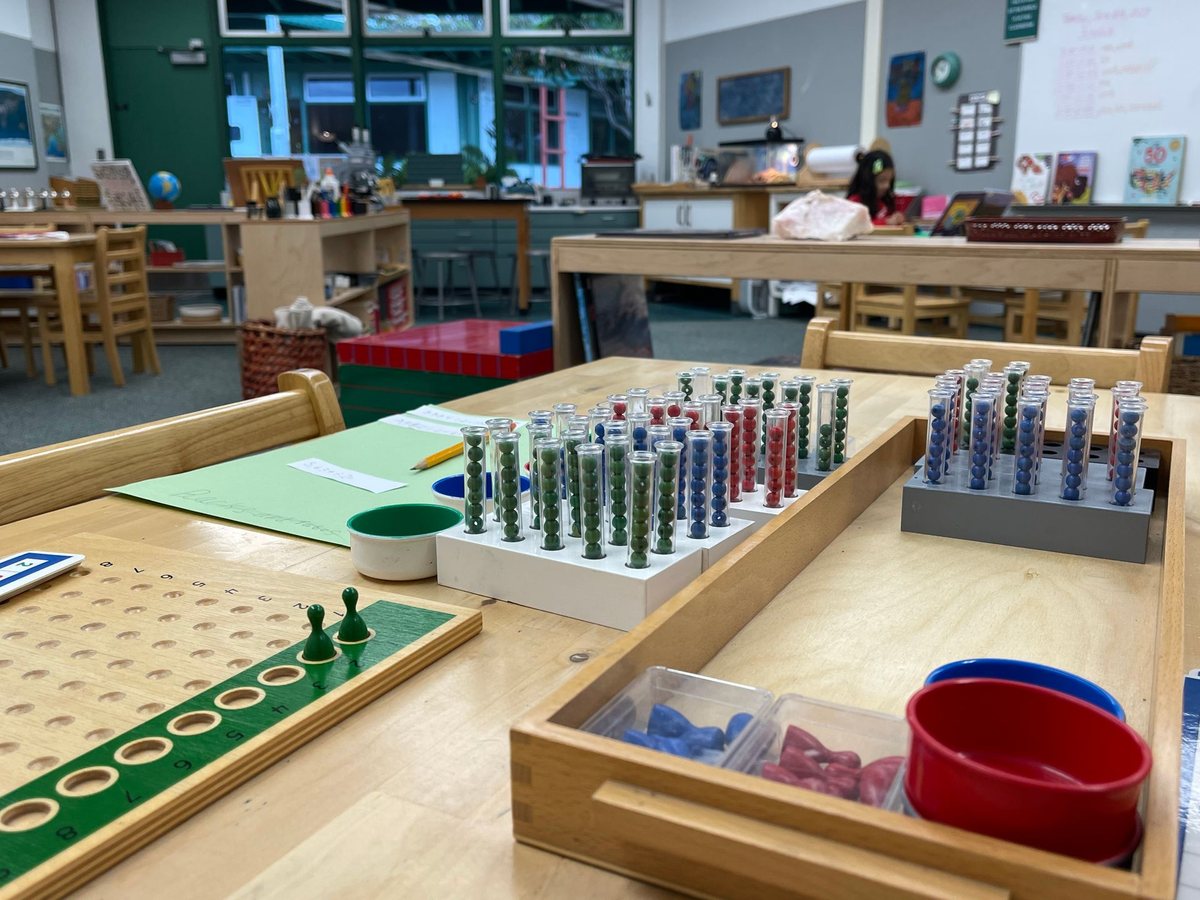
On a first visit to a Montessori classroom, you may find yourself looking for the teacher. Nobody is standing at the front. One adult is sitting on the floor beside a single child. Another is watching from a low chair with a notebook open. It is natural to wonder what, exactly, the teachers are doing all day.
Quite a lot. It just looks different from the teaching most of us remember. Montessori called the adult in the room a guide, and our staff titles use the word. Leah, who has been at South Coast Montessori since the day it opened, is a Primary Lead Guide.
Here is what the role of the Montessori teacher involves, why it is built this way, and what it means for your child.
A guide prepares the room before teaching anything
Much of a guide's work happens before the children arrive. The shelves are low enough for a child to reach. Each material has one place, and it goes back there when the child is done. Real objects sit beside the materials, so a child can study a geode itself rather than a picture of one.
The reason is that the room does a great deal of the teaching. A child who can find, use, and put away their own work does not have to wait for an adult before learning something. The guide keeps adjusting the room as the children change, adding a new material for a child who is ready and moving one that no longer draws anyone. Montessori called this the prepared environment.
For your child, it means independence from the first morning. They can choose something worth doing without asking permission for every step.
A guide watches closely, and writes it down
If you sit in a classroom for twenty minutes, you will see the guides watching more than talking. They note what each child chooses, how long they stay with it, where they struggle, and what catches their interest.
We describe this as sitting beside. The word assessment comes from the Latin for "to sit beside," and our teachers observe children as they work, taking notes and adjusting in real time. Even a lesson checks understanding as it goes. The three-period lesson, one of the hallmarks of the method, shows a guide on the spot whether a child has grasped a new idea.
For your child, it means the next lesson arrives when they are ready for it, not when the calendar says so. A guide who has watched your child all week knows what to offer on Monday.
A guide teaches one child, or a few, at a time
Instead of one lesson for the whole class, a guide gives many short lessons through the morning. In Primary, that is usually one child at a time, at a table or on a rug. In Elementary, lessons come in small groups, so each child has room to ask questions, share what interests them, and add something of their own.
The rest of the room keeps working while a lesson happens. Children practice what they were shown earlier, or choose new work from the shelves. Older children often help younger ones, which is one of the benefits of multi-age grouping.
For your child, it means a lesson pitched at exactly their level, given by an adult close enough to see their face.
A guide sets the limits that make choice work
Montessori children choose their work, and a common worry follows. What if my child only ever chooses one thing? Children choose within carefully crafted limits, and setting those limits is the guide's job. Teachers observe every day to make sure each child is progressing in every area, and they gently steer children toward the subjects they have been avoiding.
Here is how that can look. Imagine a child who would happily spend every morning at the botany shelf and never open a math material. A guide might talk with them about how they plan their week. They might find a way into math through plants, by counting petals or measuring stems. Sometimes a small change in the room is enough.
In our Elementary, structure shows up in three habits. Each child keeps a daily journal of what they accomplished. The teacher holds periodic one-to-one conferences to check that every child is working across the whole curriculum. And every student in grade 3 and above takes a yearly standardized assessment, one of many tools the teachers use.
A guide brings years of training to the room
Behind the calm is specialized training in how children develop at each age. Our Primary and Elementary teachers are AMI-trained, and the school is dedicated to the principles of AMI, the Association Montessori Internationale.
Leah trained in AMI Primary at the Washington Montessori Institute in 2001 and holds a master's in Montessori Education from Loyola University. Claudia, our Primary Program Teacher, completed her AMI Montessori studies at the Montessori Institute of San Diego in 2015. In Elementary, Frances graduated from the International Center for Montessori Studies in Bergamo, Italy, and has taught at the elementary level for over 40 years. Bea completed her AMI 6 to 12 training in France in 2015. Our infant team is trained to observe each infant's development closely and to know what to offer next.
For your child, it means the adult deciding what comes next knows what to look for at three, at six, or at nine. Every guide's bio is on our Staff & Board page.
A good guide works toward being needed less
Montessori put the goal of the role in one line. AMI/USA quotes it from The Secret of Childhood: "The greatest sign of success for a teacher... is to be able to say, 'The children are now working as if I did not exist.'"
You can watch for that on a tour. Pick one guide and follow them for five minutes. Notice how often they speak, how close they sit, and how the children carry on when the guide moves away.
Schedule a tour and watch a guide at work. Or read more of the words you'll hear on a tour, and what each one looks like in the room.
Questions parents ask about Montessori teachers
If the teacher isn't teaching the whole class, how does my child learn?
Through short lessons given to one child or a small group, followed by practice the child chooses. The guide watches each child closely and gives the next lesson when the child is ready for it. Between lessons, the room is set up so children can find and use their own work. Older children often help younger ones as well.
How does a Montessori guide know my child is keeping up?
By watching and recording. Our teachers observe children as they work, take notes, and adjust in real time, and the three-period lesson checks understanding during the lesson itself. In Elementary, children also keep a daily journal, meet one-to-one with their teacher, and from grade 3 take a yearly standardized assessment. Ask your child's guide what they have seen; we set aside time for those conversations.
What training do the guides at South Coast Montessori have?
Our Primary and Elementary teachers are AMI-trained, and the school is dedicated to the principles of AMI, the Association Montessori Internationale. Their training includes institutes in Washington, San Diego, Bergamo, and France. Our infant team has studied Early Childhood Education, most of them at Santa Barbara City College. Each guide's training is listed on our Staff & Board page.

Posted by
South Coast Montessori