
Montessori Method
The role of the Montessori teacher: what a guide does all day
Nobody stands at the front of a Montessori classroom. Here is what the Montessori teacher, or guide, does all day, and what it means for your child.
Articles on how Montessori works and why, starting with the words you'll hear on a tour.

Montessori Method
Nobody stands at the front of a Montessori classroom. Here is what the Montessori teacher, or guide, does all day, and what it means for your child.
Somewhere on a school tour, a guide mentions the work period, or practical life, or a three-period lesson, and you nod. Everyone else seems to know what that means. Asking feels like admitting you skipped the reading. Montessori does have its own vocabulary, but nearly every word in it names something you can see with your own eyes. Here are eight of them, in roughly the order you'd notice them walking into one of our classrooms.
Picture a four-year-old carrying a tray to a table. They pour water from one small jug into another, wipe up the drips, and then do it again. Nobody asked them to. They chose it from the shelf, and they may repeat it several times before putting the tray back.
In Montessori, that is called work. The word is deliberate. It treats what a child chooses to do as purposeful effort, worth respecting and worth finishing. Work usually follows a lesson: a guide shows a child how to use something, and the child then practices on their own. Our Elementary schedule puts it in one line: lessons are given, and follow-up work is done.
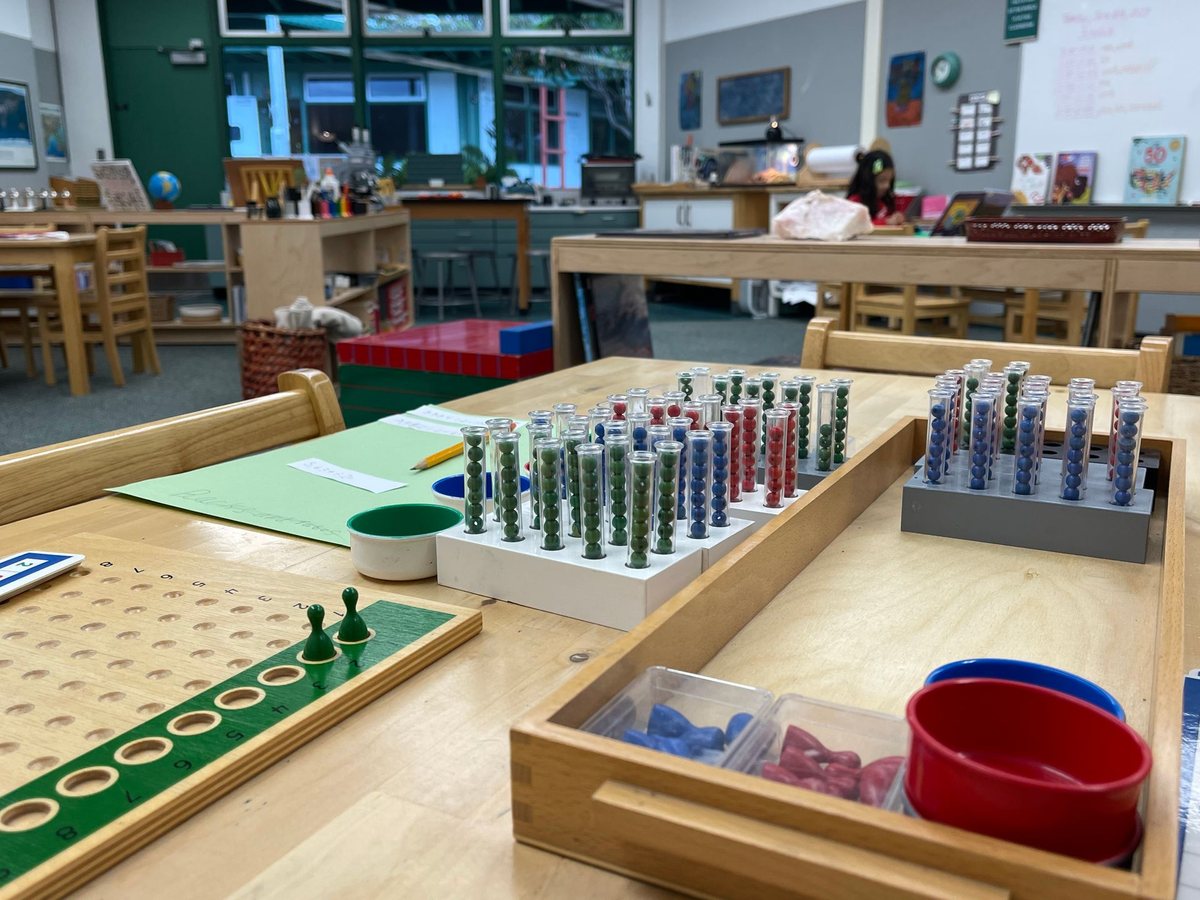
The first thing most parents notice is the room itself. Almost everything is at a child's height. Each material has one place on one shelf, and a child can take it down, use it, and put it back without asking an adult.
Montessori called this the prepared environment. Each stage of childhood is best met in a rich and carefully prepared environment, so the room is arranged on purpose rather than filled. Looking after it is part of the children's work, too. Montessorians call that care of the environment. The order on the shelves is intentional, too. Children between three and six have a strong sense of order, and a room where every material has its place speaks to it. It's why we say the room itself is a teacher. Why we build our rooms this way is the sixth of our six principles.
On the Primary shelves, the materials fall into areas, and each area has a job. Practical life is everyday work: pouring, preparing food, and caring for the room. Sensorial materials sharpen what a child notices through their senses. Mathematics materials make numbers something a child can handle. Language work covers speaking and listening, and later reading and writing. Grace and courtesy is the practice of the manners that let a group share a room.
Lessons also reach into history, geometry, biology, geology, and geography. Real things sit on our shelves beside the materials, like a geode or an owl pellet, so children study the object itself rather than a picture of it. How Primary uses all of this, year by year.
You may notice that the adults rarely stand at the front of the room. They move between children, watch closely, and sit down beside one child at a time to give a short lesson. That is why Montessori calls them guides. Behind the title is training. Our teachers are trained in the stages of development of the children they work with, so they know what to look for at three, at six, or at nine.
The title describes the job. A guide's work is to observe each child and bring them the next thing they are ready for, one lesson at a time. At South Coast Montessori you'll see the word in staff titles: Leah, for example, is our Primary Lead Guide. The role of the Montessori teacher goes deeper into what a guide does all day.

There are stretches when a child seems hungry for one particular thing and takes it in with surprising ease. Montessori called these sensitive periods: windows when a child is especially ready to learn a specific skill. Our curriculum is planned around them. Principle 02 on Why Montessori explains how.
Watch a guide teach a new word to a three-year-old and you may see three short steps. First, the guide names the thing: "This is rough. This is smooth." Next, the guide asks the child to find it: "Can you show me smooth?" Last, the guide asks the child to name it: "What is this?"
Each step asks a little more of the child. If the child stumbles at the third step, the guide knows on the spot and goes back to the second. That's the point of it. Understanding is checked while the lesson is happening, so the guide can adjust before the child moves on. Montessori calls this the three-period lesson, and it is one of the hallmarks of the method.
In a Primary room, three-year-olds work near five-year-olds, and that is by design. A Montessori classroom holds three ages, and a child stays in the same room for the whole span. This is called the three-year cycle. A child arrives as one of the youngest and leaves as one of the oldest. In Primary, that final year is the kindergarten year.
When the families who founded South Coast Montessori built the school, mixed-age classrooms and three-year cycles were among the things they were determined to keep. Our Elementary works the same way, in two stages: grades 1 to 3 and grades 4 to 6. The reasons mixed ages work are a story of their own, told in the benefits of multi-age grouping.
Three letters turn up in our teachers' training and on our website: AMI. AMI is the organization Maria Montessori created to ensure the authenticity of her method. Our wording is exact: South Coast Montessori is "dedicated to the principles of AMI (Association Montessori Internationale)."
That phrase describes how we teach and the training our guides bring. Dedication to AMI principles and AMI accreditation are two different things, and any school you visit should be able to tell you plainly which one it means. For more on judging whether a school's Montessori is authentic, see our answer on Why Montessori.
On a tour, ask the guide to show you a three-period lesson, or a piece of work waiting on a shelf. See a classroom for yourself.
Because it is chosen, purposeful, and often repeated until the child is satisfied with it. Calling it work is a way of taking a child's effort seriously. A lesson usually comes first, and the work is the child's own practice afterward. From across the room it can look like play, and it is often joyful. The word tells you the adults respect it.
Because most of their job is guiding one child at a time, rather than instructing a whole class at once. A guide watches closely, decides what each child is ready for next, and gives that child a short lesson. Our staff titles use the word, such as Primary Lead Guide. For more, read the role of the Montessori teacher.
It is a short, three-step way of teaching something new. The guide names it ("This is a triangle"), asks the child to find it ("Show me the triangle"), and then asks the child to name it ("What is this?"). Because each step asks a little more, the guide can see exactly where understanding stops and adjust right then. It is a Montessori hallmark.
AMI, the Association Montessori Internationale, is the organization Maria Montessori created to ensure the authenticity of her method. When we say South Coast Montessori is "dedicated to the principles of AMI," we mean our classrooms follow those principles and our Primary and Elementary teachers are AMI-trained. It describes training and practice. It is not a claim of AMI accreditation. For how to judge any school's Montessori, see our answer on Why Montessori.

What is changing in your child from birth to twelve, and what each stage is ready for.
View articles
Small, practical ways to bring what works in the classroom into your own home.
View articles
What children do all day in a Montessori classroom, from the morning work period to lunch.
View articles
Help with the decision in front of you: what to look for in a school, and what to ask.
View articles
School news, the events that shape our year, and what the local press has written about us.
View articlesLooking for something specific? Search every article on the blog.
Search articles