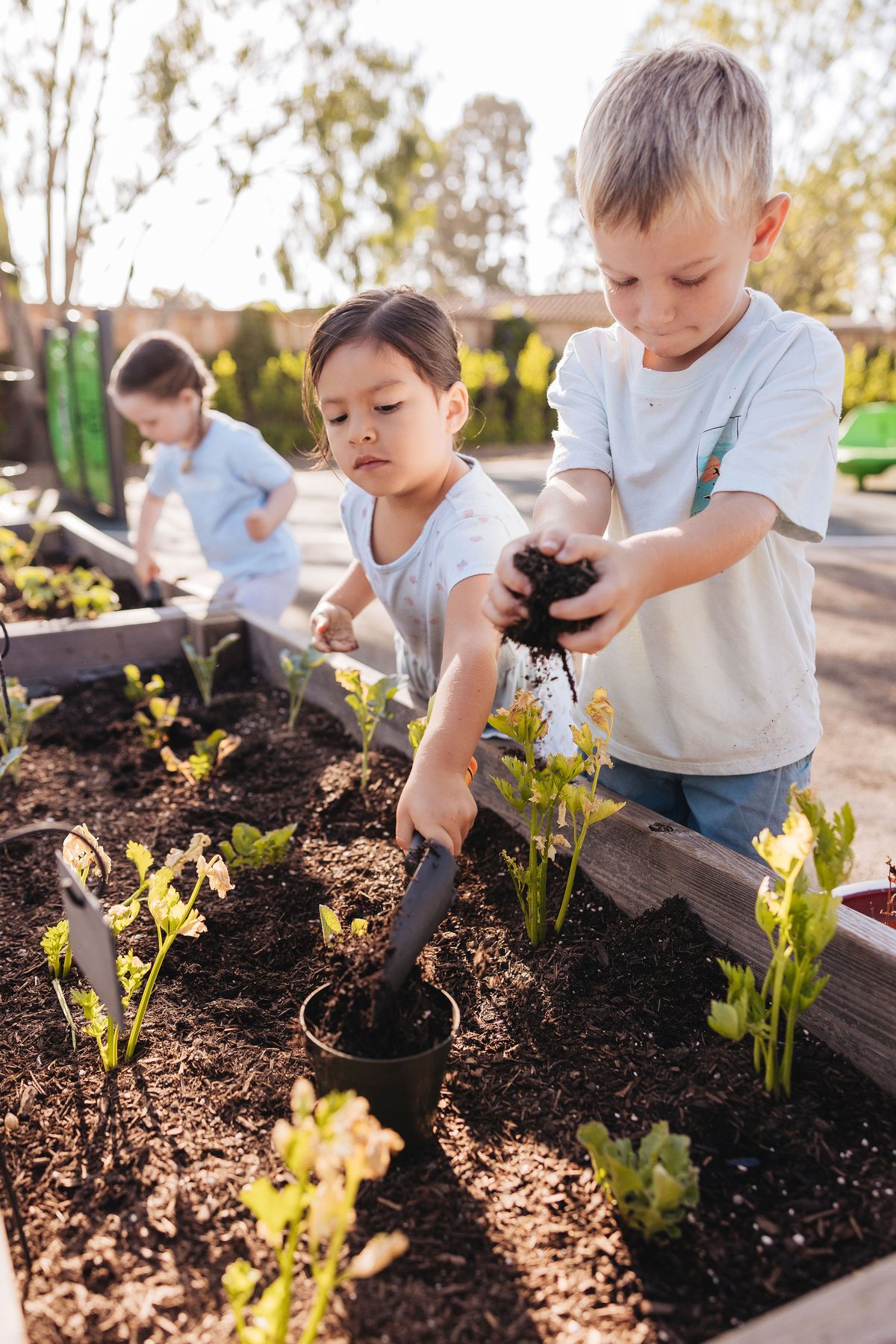
Picture your three-year-old walking into a room where some of the children are nearly six. Two worries tend to arrive together. Will the little one be overwhelmed? And if your child is the oldest, will they spend their last year looking after everyone else?
Both are fair questions. Most of us went to school with children born the same year we were, so a room of three ages can look like a compromise. In a Montessori classroom, multi-age grouping is the design. It was also one of the things the families who founded South Coast Montessori were most determined to keep.
Here is what mixed ages do for a child at each point in the cycle, and what to watch for when you visit.
The youngest children learn by watching
The worry is that a small child will be lost among bigger ones. What happens in the room is closer to the opposite. A three-year-old in a mixed-age room is surrounded by children who already know where everything goes and how the day runs. They watch an older child work with a material they will use themselves in a year or two. They see how a tray is carried, how a spill gets wiped up, and how a disagreement gets talked through.
Much of a young child's learning in these first months comes from other children, alongside the guides. Our oldest Primary children are expected to act as kind mentors for the younger ones. Asking an older child for help is an ordinary part of the day.
On a visit, look for a young child standing just beside an older one's work, watching closely. That watching is how the next lesson starts.
Every child works at their own level
The worry here is comparison. Will my child be the one who is behind, or the one who is bored? In a room that holds three ages, the shelves hold three years of materials, and there is no single lesson the whole group has to keep pace with. A child who needs more time with something gets it. A child who is ready to move on finds the next step already on the shelf.
Because the ages mix, children are always doing different things, and nobody stands out for it. In our Elementary, grades 1 to 6 learn in one program, and the grade level is not a ceiling. A child is encouraged to go as far as they are able. It also means a new student joining from another school is not the only one working on something different from the child beside them.
On a visit, notice two children of the same age doing completely different work, and neither one looking at the other's.
The oldest children lead, and their own work keeps growing
This is a common worry about the final year, especially when a public kindergarten or TK place is also on the table. Will my child just be a helper? In practice, the oldest children do two things at once. They lead, and they take on the hardest work in the room.
We call the final Primary year, the kindergarten year, a year of consolidation and mastery. The oldest children care for the room and help the younger ones. Showing a three-year-old how a material works asks a child to understand it well. Their own lessons keep moving too. While the younger children rest after lunch, our older Primary children have an afternoon work period with lessons for their age. Some are invited into lessons in the Elementary classroom. In Elementary, the children in grades 4 to 6 take on longer research and writing and plan more of their own time.
On a visit, look for an older child explaining something to a younger one, then going back to work that is clearly harder than anything around it.
Three years in one room means your child is known
There is a quieter worry, and it belongs to parents. In a school organized by single grades, every September means a new teacher, new expectations, and a few weeks of getting to know each other again. In a mixed-age room, a child stays for the whole cycle. The adults in that room come to know your child over years, not months, and they come to know your family too.
That continuity is easy to see here. Leah, one of our Primary lead guides, has been at South Coast Montessori since it opened in January 2017. We also set aside time for parents and guides to talk about each child's growth and needs. Over three years, those conversations build on each other.
On a visit, ask a guide how long they have taught in that room, and what they know about a child by their third year.
Moving on happens when the stage changes
Eventually every child leaves the room they know, and it can be bittersweet for the whole family. Montessori set the age groupings by the stages of development she observed, with big changes around three, six, and twelve. So a move to a new room tends to come when a child is ready for something new.
Here, our infants move into the older-infant room once they are walking, gradually and with no set date. At 18 months comes our Toddler community, then Primary from three to six, then Elementary through sixth grade. Because Primary children are already invited into Elementary lessons, the next room is not a stranger's room. For more on why the rooms are grouped at those ages, read the planes of development.
Watch a mixed-age room at work
A mixed-age classroom is hard to picture and easy to understand once you stand in one. On a tour, give it five minutes. You will likely see a younger child watching, an older child explaining, and a guide letting both happen.
Schedule a tour of our classrooms. Or see what fills the rest of the school day in our Classroom Life articles.
Questions parents ask about mixed-age classrooms
Will my three-year-old be overwhelmed by older children?
Usually the older children make the room easier for a young child to join, not harder. They already know the routines and where everything goes, and our oldest Primary children are expected to act as kind mentors. A young child learns a great deal simply by watching them work. If you are unsure how your child would settle, ask the guides about it on a tour.
Does my oldest child just end up looking after the younger ones?
No. The oldest children do help and lead, and that asks them to know their own work well. Their lessons keep moving too. Our older Primary children have an afternoon work period with lessons for their age while the younger children rest, and some join lessons in our Elementary classroom. We think of the kindergarten year as a year of consolidation and mastery.
What if my child is ahead of or behind other children their age?
In a mixed-age room, that matters less than you might expect. The shelves hold three years of materials, and each child works at their own level, so there is no whole-class pace to fall behind or wait for. In our Elementary, the grade level is not a ceiling, and each child is encouraged to go as far as they are able.

Posted by
South Coast Montessori