Your four-year-old wants the cups in the cupboard lined up just so. Two years later, the same child can't keep track of a shoe, and argues over the rules of every game until nobody is playing it. Some weeks it can feel as if you are raising a different child every few years.
In a sense, you are. Maria Montessori described childhood as a series of four planes of development, each with its own drives and its own needs. Once you know which plane your child is in, a lot of baffling behavior becomes something you can read and answer.
Our classrooms at South Coast Montessori are arranged around these planes, from the Nido for our youngest infants to sixth grade. Here is what each plane looks like, why it happens, and what helps, at school and at home.
Four planes of development, each about six years long
Montessori's four planes run from birth to six, six to twelve, twelve to eighteen, and eighteen into adulthood, usually given as about twenty-four. The Association Montessori Internationale (AMI) calls the planes an overall vision of Montessori's developmental psychology. Each one has a character of its own.
Each plane also divides into two halves. AMI describes them as three years of creation and three years of crystallization. In the first half something new is built, and in the second it settles and grows strong. That rhythm is the logic behind Montessori's three-year classrooms. Our Primary holds children from three to six, and our Elementary runs as two stages, grades 1 to 3 and grades 4 to 6.
For a parent, the value of the model is simple. It tells you what your child is reaching for right now, so you can offer it instead of fighting it.
Birth to six: a child building themselves
An infant watches everything. A toddler pulls your hand away from the zipper. A five-year-old spends ten minutes pouring water from one small jug into another, then pours it all back and starts again.
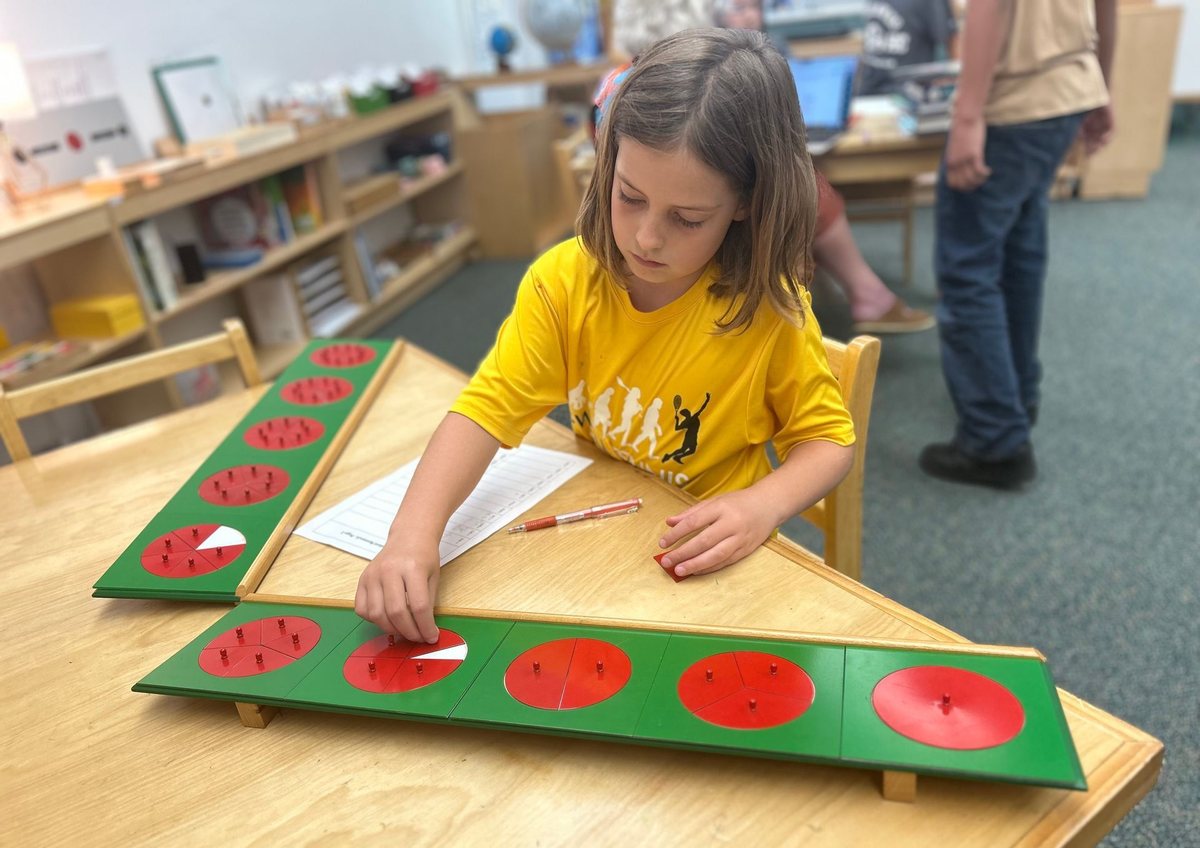
Montessori called the mind of this plane the absorbent mind. In the first three years, a child takes in language, movement, and the feel of the world without conscious effort. From about three, learning becomes deliberate, and it runs through the hands. Children in the second half of this plane also have a strong sense of order. They notice when a thing is out of place, and they like a task with many steps done the same way each time. The drive behind all of it is physical independence: dressing, eating, pouring, and carrying without help.
What helps is time, and things within reach. In our Nido, most of the room sits at an infant's height, with mirrors near the floor and low shelves of materials. In our Toddler rooms, children set the table, wash their hands, and learn to dress themselves. At home, the same idea fits into a single low hook or shelf, and our Parenting at Home articles have ideas for each age.
Six to twelve: a mind that wants to know why
Around six, your child turns outward. Friends become a group with a name and a set of rules. Fairness matters intensely. Questions start with why and rarely stop at one. Their body changes too. A growth spurt can leave them bumping into furniture, their first teeth start to fall out, and the tidiness of the early years often fades.
This is the plane of the reasoning mind. A child now wants to understand how things began and how they connect, and an idea lands best when it arrives as a story. Montessori Elementary classrooms open big subjects with dramatic stories called the Great Lessons, then let children follow the threads into science, history, and geography. Where the first plane reached for physical independence, this one reaches for intellectual independence. A child wants to work it out for themselves, with friends.
So our Elementary gives lessons in small groups, lets children choose where and with whom they work, and builds projects that a group plans together. Students even research and help organize their own Going Out trips. At home, try answering a why question with "How could we find out?" Let your child write the rules for a family game, and expect to argue about them.
Twelve to twenty-four: independence, then a place in the world
Adolescence is the third plane, from twelve to eighteen. Friendships become critical, and a young person wants independence from adults before they are fully ready for it. Montessori's answer was a structure that lets them try independence safely. She imagined a farm school, which she called Erdkinder, or children of the earth. There, adolescents would keep a working farm running and share in planning and decisions. During these years, a young person is refining a moral compass and taking on real responsibility.
The fourth plane, from eighteen to about twenty-four, is the move into adult life. Young adults often live away from home for the first time, choose a course of study or work, and begin to see more clearly who they are.
South Coast Montessori serves children through sixth grade, so these planes come after a child leaves us. The habits of the Elementary years point toward them, though. Our Elementary students keep a daily journal of their work, plan more of their own time as they get older, and the oldest often lead the younger ones.
Using the planes when your child surprises you
The planes earn their keep on an ordinary Tuesday. When your child does something that puzzles or frustrates you, three questions help. Which plane is my child in? What is this plane reaching for? What could I offer, instead of only stopping it?
Here is how that might go. Say your seven-year-old has stopped keeping their room tidy, but will spend an hour inventing a club with rules and membership cards. Read through the planes, that is not laziness. The first plane's sense of order is fading, and the second plane's drive toward friends and fairness is arriving. You might simplify the tidying to two bins and a hook, and let the club have its meeting.
The ages are approximate, and children cross from one plane to the next at their own pace. Montessori's conviction was that a child who has lived one plane fully, in surroundings prepared for it, arrives at the next one ready. For more on what each of our rooms offers each age, start with our Child Development articles.
See each plane in a classroom built for it
The difference between the planes is easier to see than to read about. On a tour, you can walk from a room where children are learning to pour and button to one where a small group is planning a research project. Our first tour is for adults only, so you can ask the guides what they watch for at each age.
Schedule a tour and see a room built for each age. If you would rather keep reading first, our six principles show how the planes shape everything we do.
Questions parents ask about the planes of development
Does every child move through the planes at the same age?
No. The ages Montessori gave are approximate, and each child crosses from one plane to the next at their own pace. The order is what holds steady. A child builds physical independence first, then intellectual independence, then social independence in adolescence. Watching for the signs of a new plane tells you more than the birthday does.
How can knowing the planes of development help at home?
It tells you what your child is reaching for, so you can offer it. A toddler who insists on dressing alone is building physical independence, so extra time and clothes they can manage help more than stepping in. A seven-year-old who argues about rules is developing a sense of fairness, so letting them help set family rules works with that drive instead of against it.
What changes when my child turns six?
Around six, children enter the second plane. They turn toward friends and groups, care a great deal about fairness, and ask why about almost everything. Their imagination is wide awake, so ideas land best as stories. It is also when they are ready for Elementary. At South Coast Montessori, Elementary runs from grades 1 to 6, ages 6 to 12.

Posted by
South Coast Montessori