
Classroom Life
The benefits of multi-age grouping, from the youngest to the oldest
Worried a mixed-age classroom will overwhelm your youngest or hold back your oldest? Here is what multi-age grouping gives a child at every age.
What children do all day in our classrooms, from the long morning work period to lunch, rest, and time outside.

Classroom Life
Worried a mixed-age classroom will overwhelm your youngest or hold back your oldest? Here is what multi-age grouping gives a child at every age.
You ask what they did at school today. The answer is "work," or "nothing," or a long story about what a friend had for lunch. You see the classroom at drop-off and again at pickup, and the hours in between are mostly a mystery. Here is what fills them, from the first long stretch of the morning to the walk out the gate.
The morning is built around one long, uninterrupted stretch of work. Nobody moves the class from math to reading on a timer. Instead, guides give lessons through the morning, and children do the follow-up work that comes after them, each at their own pace. In Elementary, this morning work period runs for three hours. In the Toddler room, the morning mixes work and lessons with books, art, gardening, music and movement, and food preparation. The children set out their own snack and clear it away.
The length is the point. Concentration takes time to build, and a child who has just settled into something difficult is not pulled away by a schedule. Over a morning, one child might finish yesterday's botany work, take a new math lesson, and then spend a long time on a piece of writing. Another might do the same things in a different order. Elementary's full daily schedule shows how the day is laid out.
Look in partway through a morning and children are spread across the room. One works alone at a table. Two sit on a floor mat with a material between them. A small group talks through a project they are building together. The guide sits beside one child to give a short lesson, then moves on to the next. Guides take notes as they watch, which is how they know what each child needs next. How assessment works in a Montessori room.
Older and younger children share the same room, and the older ones often help the younger. It can look loose at first glance. Then you notice that almost every child is busy with something they chose. How mixed ages work is the subject of the benefits of multi-age grouping.
Children who share a room will disagree. Montessori classrooms treat that as a chance to teach, and conflict resolution is taught as a real skill. From the Toddler room up, children practice grace and courtesy with one another. The adults model it every day and guide each interaction as it happens.
By Elementary, the same habits grow into leadership. Melinda Creman, our Lead Elementary Guide, described it to the Santa Barbara Independent:
“Leadership in Montessori is a powerful tool,” explained Melinda Creman, Lead Elementary Guide of South Coast Montessori.
In a mixed-age room, children who have gone further in a subject help guide the ones who are newer to it. Read the Independent's piece on leadership, grace, and courtesy.

In the Toddler room, lunch is a community meal, eaten together before nap. In Toddler and Primary, the younger children rest after lunch. The older Primary children have an afternoon work period instead, with lessons for their age. Across the Primary day, art, music, and creative expression run through every area of the curriculum.
Elementary afternoons have their own rhythm. After lunch comes time outside, a stretch of silent reading, more work on the morning's projects, and a read-aloud before pickup.
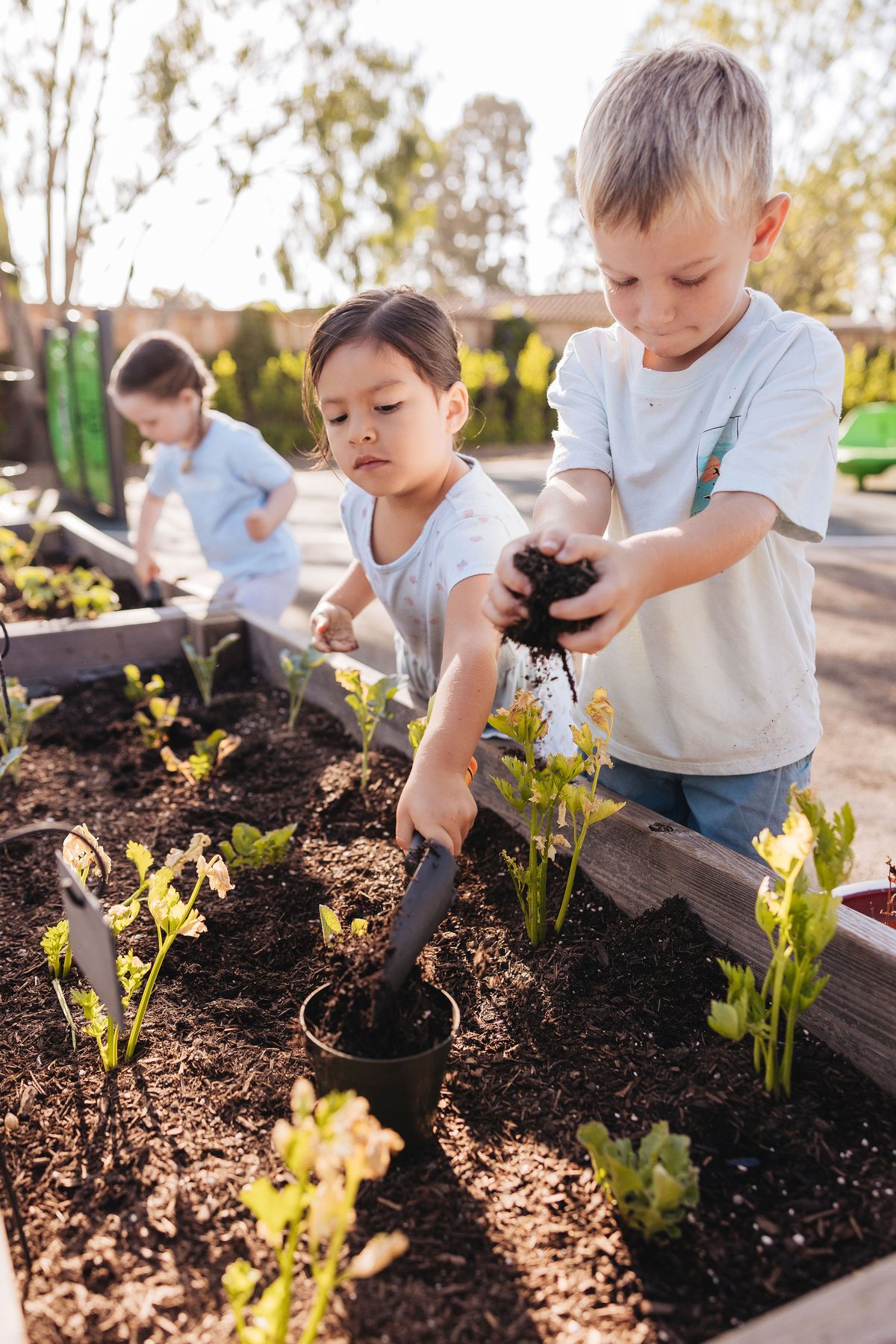
Nature is part of the day. Children garden, care for living things, and begin natural studies like botany and zoology at the Primary level. The outdoor spaces themselves show what our families have done. Money raised at the Move-A-Thon remodeled the infant yard in 2022, and the 2022/2023 Giving Campaign and Move-A-Thon helped completely renovate the toddler yard. The toddler yard has a sandbox, wheelbarrows, balls, and a climbing structure, and toddlers also walk out to explore the big field on campus. See what families' giving has built.
Elementary students also leave campus. On Going Out trips, they help plan where to go and why, then see what they studied in class out in the world. In 2026 that included a beach day. Read Noozhawk's story about Going Out.
If you'd like to watch a morning work period for yourself, visit a classroom.
It is a long, uninterrupted block of time, usually in the morning, when guides give lessons and children do the work that follows them. Nobody changes subjects on a bell. In Elementary, the morning work period lasts three hours, which gives children time to concentrate deeply and finish what they start.
Both. Children can work alone or in groups, on the floor or at a table. Younger children often work side by side on their own work. Older children, especially in Elementary, choose where and with whom they work, and often plan projects together in small groups.
As something to learn from. Conflict resolution is taught as a real skill, and children practice grace and courtesy with one another from the Toddler room up. Adults model the words to use and guide children through a disagreement as it happens, so over time children can work it out themselves.
In the Toddler room, yes: lunch is a community meal, eaten together before nap. Lunch is part of the school day in every program, and each program page shows when it falls: Infant, Toddler, Primary, and Elementary.

What the method is, why it works the way it does, and what the words you hear on a tour mean.
View articles
What is changing in your child from birth to twelve, and what each stage is ready for.
View articles
Small, practical ways to bring what works in the classroom into your own home.
View articles
Help with the decision in front of you: what to look for in a school, and what to ask.
View articles
School news, the events that shape our year, and what the local press has written about us.
View articlesLooking for something specific? Search every article on the blog.
Search articles