
Child Development
The planes of development: what your child needs at each age
Montessori's planes of development explain why your child changes every few years, and what helps at each age, from infancy to twelve.
What is happening in your child at this age, why it is happening, and what usually comes next.

Child Development
Montessori's planes of development explain why your child changes every few years, and what helps at each age, from infancy to twelve.
A game in the backyard stops for twenty minutes while everyone argues about the rules. A child who never noticed a mess now lines up their shoes in a particular order. Changes like these can seem to arrive overnight. They are rarely random. They tend to come in a recognizable order, and Montessori built an entire approach to education around that order. Knowing where your child is in it makes a lot of everyday moments easier to read.
Montessori described four planes of development, each lasting roughly six years. Each has its own clear characteristics: what a child is driven to do, how they learn best, and what they need from the adults around them. The first runs from birth to six, the second from six to twelve, the third from twelve to eighteen, and the fourth from eighteen to twenty-four.
The stages are useful because they change how an adult responds. A behavior that looks like stubbornness at one age is a drive toward independence. At another age, a sudden obsession with rules is the start of a moral sense. Understanding the stage helps at home as much as at school. The planes of development explains the whole model in depth.
For the first three years, a child learns almost entirely without conscious effort. Language, movement, and the feel of the world all come in through the senses and through everything around them. Montessori called this the absorbent mind. It is also when the sensitive periods begin: stretches when a child is especially ready for a particular kind of learning. Because an infant takes in whatever surrounds them, the setting itself does a great deal of the teaching.
Our Infant program is for infants from 3 to 18 months. It is built as a calm place where they can explore and feel secure as they move through each new stage. The Toddler room, for children from 18 to 36 months, adds more life alongside other children. The adults guide each interaction with a sensitive approach, and children begin practicing grace and courtesy with one another.
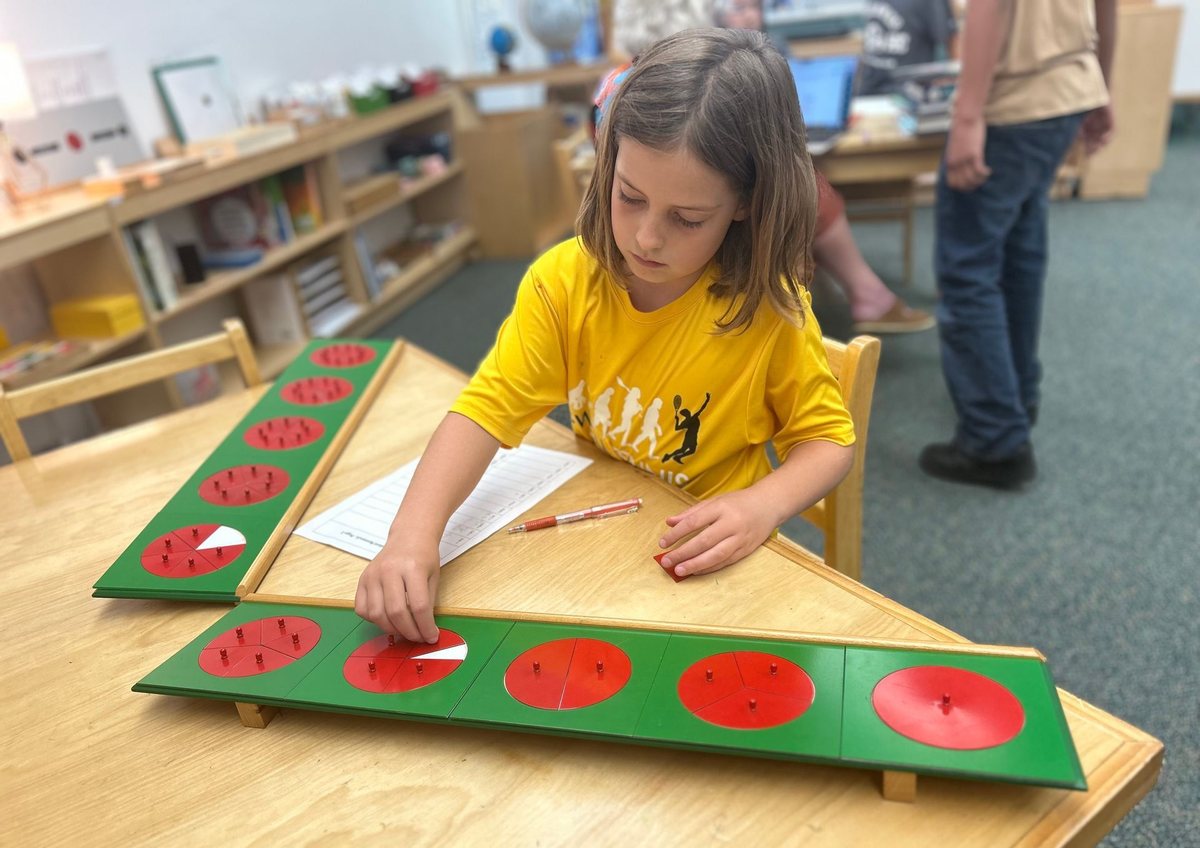
Around three, learning becomes conscious. A child now learns on purpose, and mostly through their hands. The materials in a Montessori classroom were designed with exactly this in mind. Children at this age also have a strong sense of order. They can follow the many steps of a task and enjoy it, and they notice quickly when something is out of place. The shelves in a Primary room are arranged with that in mind, and children often find the order itself satisfying.
The whole first plane, from birth to six, is summed up in one sentence children say constantly: "I can do it myself." It is a drive toward physical independence, and it is worth meeting rather than hurrying past. Each of our two Primary classrooms holds children from three to six together, and each year they go further with the same materials. Primary includes the kindergarten year.

Around six, a child turns outward. Being near other children is no longer enough. Now they want to plan, build, and argue things out together, so this is the age when collaboration can be taught. Fairness becomes urgent. So do questions about how everything began and why it works the way it does. Children in this stage are often drawn to science, history, and geography, and their imaginations are wide awake. Where the first stage was about physical independence, this one is about intellectual independence: working things out for themselves.
Their bodies change, too. These years bring a marked growth spurt, and many children seem to lose track of where their arms and legs are. They bump into doorframes and knock over cups. Baby teeth start to come out, and the tidiness of the early years often fades a little. It is a body growing faster than a child's sense of it.
Montessori Elementary classrooms meet that with real information delivered through big stories, called the Great Lessons. The first is the story of how the universe began, told with props and experiments. At South Coast Montessori, Elementary gives children a three-hour morning work period. Each child is encouraged to go as far as they are able, rather than being held to the curriculum of a grade level.
Montessori described two more stages. From twelve to eighteen, adolescents rely heavily on their friends and want independence from adults before they are fully ready for it. From eighteen to twenty-four, young adults work out who they are and where they fit in the world. South Coast Montessori serves children through sixth grade, so these stages come after a child leaves us. Our Elementary page answers what happens after sixth grade.
None of these ages is a deadline. The stages describe what a child tends to be ready for, and every child arrives on their own timetable. Montessori's view was that a child who lives one stage fully, in a rich and carefully prepared environment, is ready to take on the next one when it comes. When the room matches the stage, you can see it. Leah Shannon, one of our Primary guides, described it to the Santa Barbara Independent:
“There are moments during the morning when the children are engaged with the materials and with each other in such harmony and with so much joy,” said Leah Shannon, Primary Guide at South Coast Montessori.
Read the Independent's piece on the four stages.
Knowing the stage is half of it. The other half happens at home, and Parenting at Home has ideas matched to each age.
They are the four stages Montessori used to describe how children grow: birth to six, six to twelve, twelve to eighteen, and eighteen to twenty-four. Each has clear characteristics, so an adult who knows the stage can respond to what the child needs. For the full picture, read the planes of development.
Yes. It is one of the clearest signs of the first stage, when a child's drive is toward physical independence. Montessori put it in the child's own words: "I can do it myself." Extra time, a slow demonstration, and room to finish usually go further than stepping in. In our Toddler room, children practice dressing, washing their hands, and other self-care every day.
Because a sense of moral justice develops in the second stage, from about six to twelve. Children at this age are deeply concerned with what is fair. Making up the rules of a new game can matter as much to them as playing it. It is a sign of growth, and it is a good age to let them help set the rules.
Each of our rooms matches one stretch of development. Infant runs from 3 to 18 months, Toddler from 18 to 36 months, Primary from 3 to 6, and Elementary from 6 to 12, in grades 1 to 6. A child stays with others who share the same stage. Why we mix ages within each room is answered on Why Montessori.

What the method is, why it works the way it does, and what the words you hear on a tour mean.
View articles
Small, practical ways to bring what works in the classroom into your own home.
View articles
What children do all day in a Montessori classroom, from the morning work period to lunch.
View articles
Help with the decision in front of you: what to look for in a school, and what to ask.
View articles
School news, the events that shape our year, and what the local press has written about us.
View articlesLooking for something specific? Search every article on the blog.
Search articles